

Fruit · Organic farm, Bresela
Mulberry, Red to Black and Gone in a Day
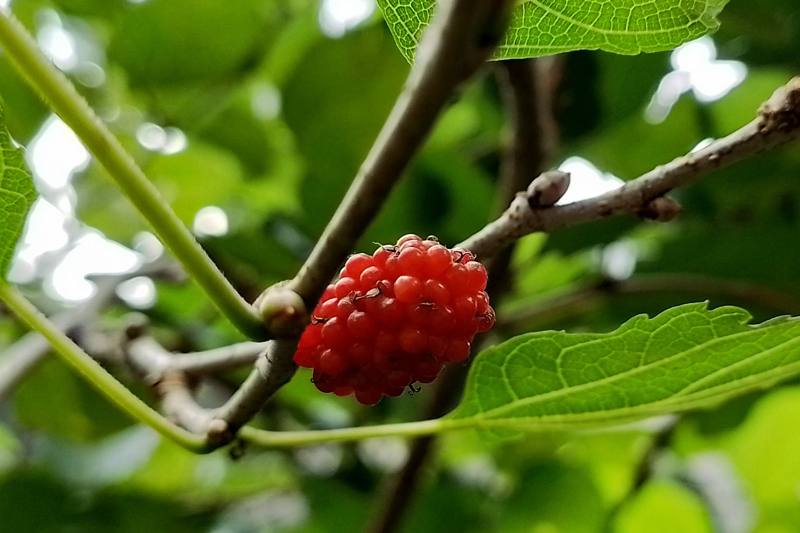
Small soft berries, red then almost black, that stain the fingers.
- English
- Mulberry
- Indonesian
- Murbei
- Botanical
- Morus sp. Moraceae
The mulberry at a glance
- Taste
- Sweet and tart, deeper and sweeter as the berry darkens.
- Texture
- Soft and juicy, with tiny seeds.
- How to eat
- Pick the darkest berries, which come away with a light touch, and eat them straight away.
- In the kitchen
- Juice, jam and a topping for desserts, according to the old farm article.
- Season
- In flushes through the year.
A berry that does not wait
Mulberries ripen in flushes, a few at a time, from green to red to almost black. A ripe one comes away from the branch at the lightest touch.
They keep for barely a day once picked, which is why fresh mulberries are rarely sold in markets. You eat them by the tree.
Taste and texture
A red mulberry is still tart. As it darkens it turns sweet and soft, with a gentle tartness underneath and tiny seeds you barely notice.
Dark juice runs onto the fingers. Expect purple hands.
Eaten warm from the sun, a ripe mulberry tastes sweeter than one from the fridge. That is a good reason to eat them where they grow.
How to pick them
Look for the darkest berries, plump and soft. Hold the stem lightly and the berry should come free; if it resists, leave it another day.
Children are quick at this, and mulberries are one of the easiest fruits on the farm for small hands. Bring a small bowl; the ripest berries crush easily in a closed hand.
In the kitchen
The old farm article says our kitchen uses mulberries for juices, jams and as a topping for desserts.
A handful stirred into yoghurt at breakfast is the simplest way to eat them.
Cooked briefly with a little sugar, mulberries turn into a dark, glossy sauce for pancakes or ice cream.
Leaves for silkworms
Mulberry leaves are the only food of the silkworm. For centuries, wherever silk was made, mulberry trees were planted by the thousand.
On our farm the trees are grown for the fruit, and birds take their share of it.
Mulberry at Sanggraloka
Mulberry grows in our organic garden at Bresela, 25 minutes north of Ubud. Ask us when you book and we will tell you whether the berries are ripening that week.
Taste it on the farm
The Thursday harvest walk follows the fruit trees. What is ripe changes week to week.

Organic Fruits
A morning walk through the fruit trees to harvest what is ripe that week and taste it fresh.

Farm Taster
A walk through the farm with a goodie bag of herbal drinks, snacks, nuts and cookies, and a guidebook to carry along.

Cooking Class
Three hours that begin with a harvest walk on the farm, then Balinese dishes with our chef. Up to ten guests.
Planning a visit
Come in the morning if you can. The paths are cooler and the leaves still hold dew.
- Who can visit
- Ask us on WhatsApp
- Entry
- Ask us on WhatsApp
- Opening hours
- Ask us on WhatsApp
- Find us
- Jl. Raya Bresela, about 25 minutes north of central Ubud and 63 km from the airport.
- What to bring
- Closed shoes, since the paths are soft after rain, and a hat.
- Booking
- Through the activity booking page, or send your date and number of guests on WhatsApp.

Questions about mulberry
When are mulberries ripe?
Mulberries ripen from green to red to almost black. The darkest berries are the sweetest and come away from the branch at a light touch; red ones are still tart.
Why are fresh mulberries hard to buy?
Ripe mulberries are soft and keep for barely a day after picking, so they rarely reach markets fresh. They are best eaten by the tree.
How does the kitchen use mulberries?
Our old farm article describes mulberries in juices, jams and as a topping for desserts. A handful in yoghurt at breakfast is the simplest way to enjoy them.
A morning among the fruit trees
Book a farm experience, or send us your date and we will tell you what is ripe that week.