

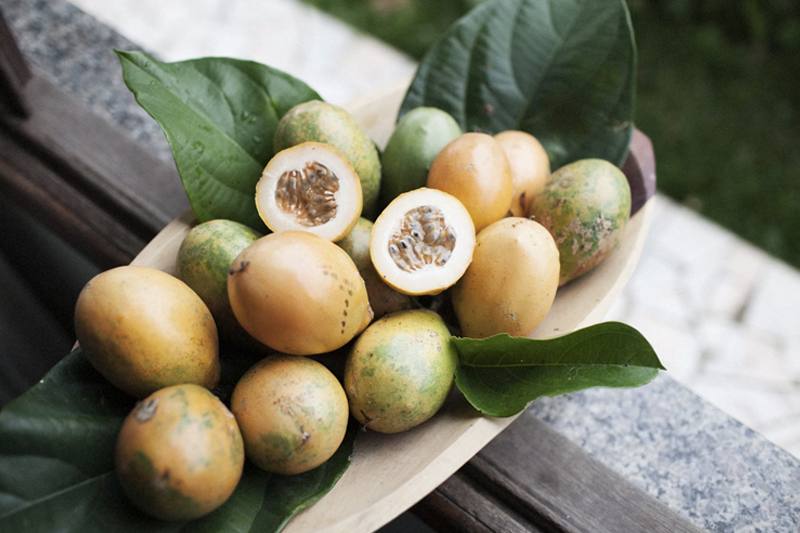
Fruit · Organic farm, Bresela
Passion Fruit, a Vine That Feeds Two Butterflies
A tart, fragrant pulp under the shell, and a vine the butterflies come back to.
- English
- Passion Fruit
- Indonesian
- Markisa
- Botanical
- Passiflora edulis Passifloraceae
The passion fruit at a glance
- Taste
- Tart and sweet at once, intensely fragrant.
- Texture
- Jelly-like pulp around small, crunchy black seeds.
- How to eat
- Cut the fruit in half and spoon out the pulp, seeds and all.
- In the kitchen
- Pressed into juice and syrup, spooned over desserts and yoghurt, stirred into dressings.
- Season
- Fruits in flushes through the year.
A vine on the fence
Passion fruit grows on a climbing vine, and on our farm it reaches along fences and frames. In Indonesian it is called markisa.
The flowers are worth stopping for: a ring of fine purple and white filaments around a crown, open for about a day.
How to eat one
Cut the fruit in half across the middle and you will find a fragrant, jelly-like pulp full of small black seeds. Eat it with a spoon, seeds and all; they crunch.
A wrinkled shell is a good sign. With the purple kind, the fruit is often sweeter once the skin has started to wrinkle.
Taste and texture
The pulp is sharp and sweet together, and the scent is stronger than the taste. A little goes a long way.
In Indonesia markisa is pressed into juice and cooked into a thick syrup that is diluted with ice water on hot afternoons. It also lifts fruit salads, yoghurt and simple desserts.
Strain the pulp and you lose the seeds but keep the scent. A spoonful in a glass of cold water with a little sugar is the simplest drink on the farm.
Food for two butterflies
The passion fruit vine is a host plant. The Malay Lacewing and the Malay Cruiser lay their eggs on vines of this family, and their caterpillars feed on the leaves.
That is one reason we let the vines grow where they like. The Malay Lacewing, orange with fine black lace on its wings, is one of the brightest visitors to the farm.
Growing passion fruit
The vine grows quickly in the warmth and rain of Bali and fruits in flushes across the year. It needs something to climb and full sun to flower well.
If you want to invite butterflies at home, a single passion fruit vine on a fence is a good start.
Passion fruit at Sanggraloka
Passion fruit grows in our organic garden at Bresela, 25 minutes north of Ubud, near the butterfly sanctuary.
Host plant
A passion fruit for the butterflies
Passion Fruit is a host plant: butterflies lay eggs on it, and the caterpillars feed on its leaves. We grow it for the kitchen and leave room for them.
Visit the butterfly sanctuaryOpen daily
Taste it on the farm
The Thursday harvest walk follows the fruit trees. What is ripe changes week to week.

Organic Fruits
A morning walk through the fruit trees to harvest what is ripe that week and taste it fresh.

Farm Taster
A walk through the farm with a goodie bag of herbal drinks, snacks, nuts and cookies, and a guidebook to carry along.

Cooking Class
Three hours that begin with a harvest walk on the farm, then Balinese dishes with our chef. Up to ten guests.
Planning a visit
Come in the morning if you can. The paths are cooler and the leaves still hold dew.
- Who can visit
- Ask us on WhatsApp
- Entry
- Ask us on WhatsApp
- Opening hours
- Ask us on WhatsApp
- Find us
- Jl. Raya Bresela, about 25 minutes north of central Ubud and 63 km from the airport.
- What to bring
- Closed shoes, since the paths are soft after rain, and a hat.
- Booking
- Through the activity booking page, or send your date and number of guests on WhatsApp.
Questions about passion fruit
How do you eat passion fruit?
Cut it in half across the middle and spoon out the pulp, seeds and all. The seeds are small and crunchy. A slightly wrinkled shell often means a sweeter fruit.
Which butterflies use the passion fruit vine?
The Malay Lacewing and the Malay Cruiser lay their eggs on vines of the passion fruit family, and their caterpillars feed on the leaves. Both are seen around our farm and the butterfly sanctuary.
What is markisa?
Markisa is the Indonesian name for passion fruit. In Indonesia it is often pressed into juice or cooked into a thick syrup, then mixed with ice water.
A morning among the fruit trees
Book a farm experience, or send us your date and we will tell you what is ripe that week.