

Fruit · Organic farm, Bresela
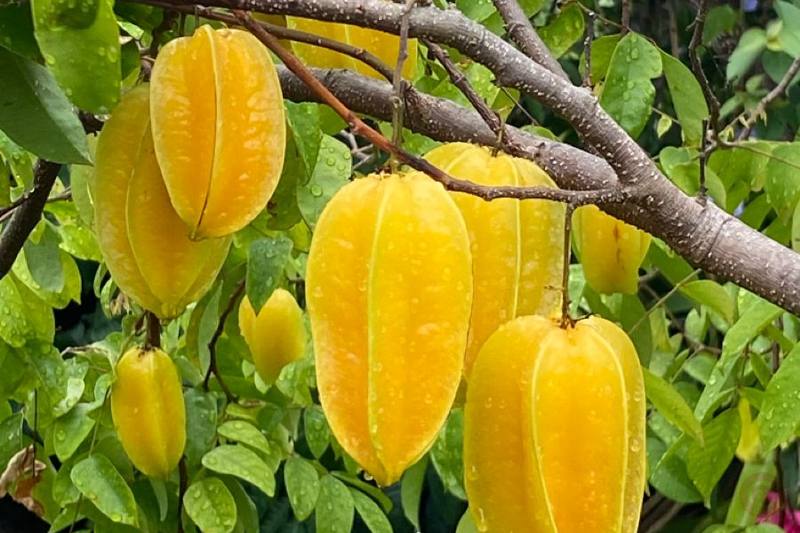
Star Fruit, a Five-Pointed Star When Sliced
Waxy yellow ridges outside, a five-pointed star in every slice.
- English
- Star Fruit
- Indonesian
- Belimbing manis
- Botanical
- Averrhoa carambola Oxalidaceae
The star fruit at a glance
- Taste
- Sweet and sour, light and juicy.
- Texture
- Crisp, juicy and waxy-skinned.
- How to eat
- Wash, trim the brown edge of each ridge, and slice across into stars. The skin is eaten.
- In the kitchen
- Eaten fresh, in rujak and fruit plates, as a garnish, or pressed into juice.
- Season
- Fruits through the year in flushes.
A star in every slice
Star fruit grows with five ridges running its length. Slice it across and every piece is a star, which is why it so often ends up on the edge of a glass.
In Indonesian it is belimbing manis, the sweet belimbing, to tell it apart from its sour cousin belimbing wuluh.
How to eat one
Wash it, trim the thin brown edge along each ridge, and slice across. The skin is waxy and thin and eaten with the flesh.
Choose a fruit that is yellow with only a little green. Deep yellow fruit is sweeter; green fruit is sharper.
The small brown seeds near the centre are easy to flick out with the tip of a knife. There are only a few in each slice.
Taste and texture
The flesh is crisp and very juicy, sweet and sour together, light rather than rich. It is a fruit for the middle of a hot day.
In Indonesia it goes into rujak with other crisp fruit, onto fruit plates, and into juice.
Sliced thin and chilled, star fruit goes well with a pinch of salt, which softens the sourness and brings out the sweet.
Who should skip it
Star fruit contains oxalate and a natural compound that people with kidney disease cannot clear well. Doctors advise anyone with kidney problems to avoid it entirely.
For everyone else it is a light, refreshing fruit. If you are unsure, ask your doctor before trying it. Everyone else can enjoy a few slices without a second thought, the way Indonesians have for generations.
On the tree
The tree is small and bushy, with soft leaves that fold at night. Small pink to purple flowers grow straight from the branches.
The old article says the leaves are used in a type of Balinese lawar.
Star fruit at Sanggraloka
Star fruit grows in our organic farm at Bresela, 25 minutes north of Ubud.
Taste it on the farm
The Thursday harvest walk follows the fruit trees. What is ripe changes week to week.

Organic Fruits
A morning walk through the fruit trees to harvest what is ripe that week and taste it fresh.

Farm Taster
A walk through the farm with a goodie bag of herbal drinks, snacks, nuts and cookies, and a guidebook to carry along.

Cooking Class
Three hours that begin with a harvest walk on the farm, then Balinese dishes with our chef. Up to ten guests.
Planning a visit
Come in the morning if you can. The paths are cooler and the leaves still hold dew.
- Who can visit
- Ask us on WhatsApp
- Entry
- Ask us on WhatsApp
- Opening hours
- Ask us on WhatsApp
- Find us
- Jl. Raya Bresela, about 25 minutes north of central Ubud and 63 km from the airport.
- What to bring
- Closed shoes, since the paths are soft after rain, and a hat.
- Booking
- Through the activity booking page, or send your date and number of guests on WhatsApp.
Questions about star fruit
How do you eat star fruit?
Wash it, trim the thin brown edge along each of the five ridges, and slice across into stars. The skin is thin and eaten with the flesh. A yellow fruit is sweeter than a green one.
Who should not eat star fruit?
People with kidney disease should avoid star fruit entirely. It contains oxalate and a natural compound their kidneys cannot clear well. For others it is a light, refreshing fruit.
What is star fruit called in Indonesia?
Star fruit is belimbing manis, the sweet belimbing. Its sour relative, belimbing wuluh, is a smaller, different fruit that Indonesian cooks use as a souring ingredient instead of lime.
A morning among the fruit trees
Book a farm experience, or send us your date and we will tell you what is ripe that week.