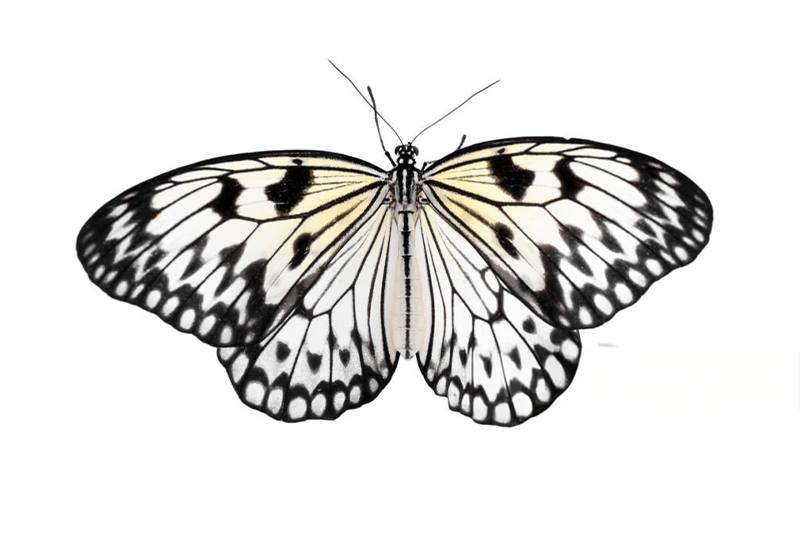
The Common Tree Nymph drifts rather than flies. Its large, semi-transparent wings are a pale, silvery white, patterned with black veins and delicate spots, and they can span up to 15 cm. It moves through the canopy as slowly as paper in a breeze.
The plant comes first
The life of the Common Tree Nymph
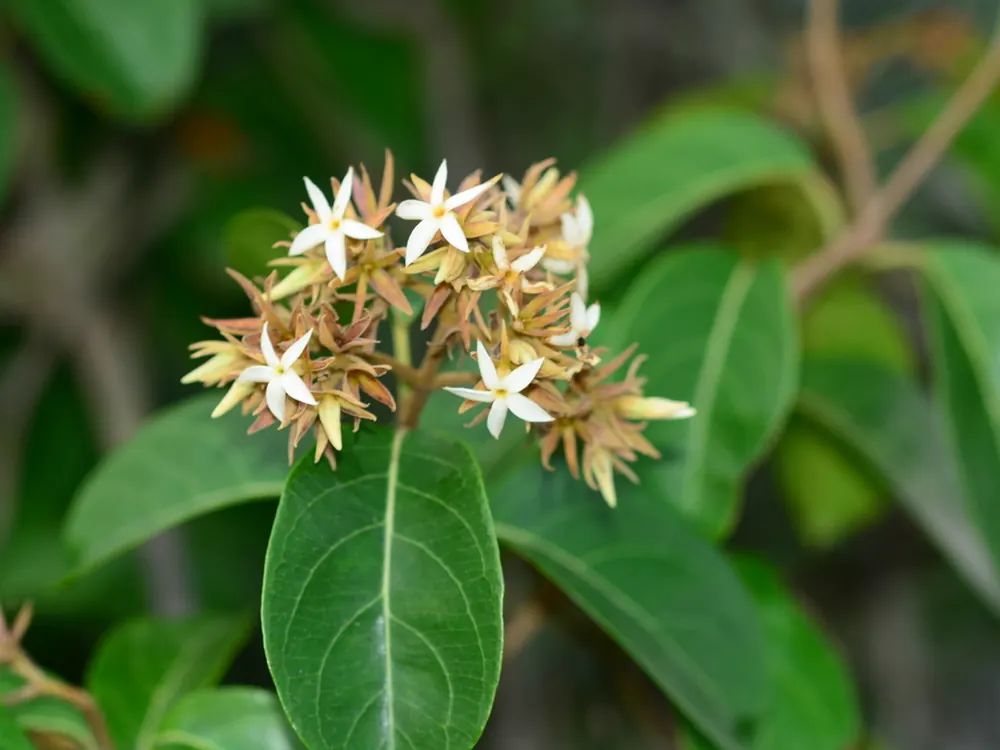
1Host plant
Climbers of the dogbane family (Apocynaceae), such as Aganosma
Feeds on Aganosma and similar vines, and stores toxins.
Photo coming soon
4Chrysalis
Hangs head down from a stem or leaf.
5Adult butterfly
Large, pale and semi-transparent. A slow glider.
Recognising the Common Tree Nymph
Look for very large, pale wings that seem to let the light through. Black veins and spots mark them, and the wingbeat is slow.
Butterflies of the genus Idea are often called paper kites or rice paper butterflies, and it is easy to see why.
In a good light the wings look almost clear, with the black veins standing out like the ribs of a leaf. Few butterflies in the garden are paler.
Climbers and caterpillars
The caterpillars feed on climbing plants of the dogbane family, such as Aganosma. These are vines of the wild kind, the ones that tidy gardens remove first.
By keeping the wild, organic nature of the gardens, we protect the vines the butterfly needs to survive.
Dogbane family climbers often bleed a milky sap when cut, and the sap is bitter or poisonous. That is the source of the butterfly's protection, passed from the vine to the caterpillar to the adult.
How it lives
Its flight is slow, gentle and unhurried. That calm is a sign of confidence, because the butterfly is unpalatable to predators and has little to fear.
Male Idea butterflies are known to visit certain wilting plants, to take up chemicals that make them more attractive to females.
A butterfly that does not hurry
Most butterflies fly quickly because they must. The Common Tree Nymph can afford to drift, since birds learn to leave it alone. The slow flight is a message to predators, and a gift to anyone watching.
That makes it a good butterfly to follow. Stand still, let it pass and follow it with your eyes. It tends to stay in view for longer than most.
Its size and its pale wings give it a lightness of motion that is quite unlike the heavy, direct flight of the swallowtails. Compare the two if both are about.
Where to look at Sanggraloka
Look up. The Common Tree Nymph glides through the canopy, and it often passes at the height of the first branches. Check the wild climbers at the edge of the garden as well.
We cannot say you will see one. It is wild, and its slow flight can carry it out of sight very quickly.
Because the Common Tree Nymph flies so slowly, you can keep it in view for a long while. Raise your eyes, follow it, and let your guide name what it is passing.
Questions about the Common Tree Nymph
How big is the Common Tree Nymph?
The wings can span up to 15 cm. They are pale and semi-transparent, so the butterfly looks lighter than it is. It is among the larger butterflies you are likely to see in the garden.
Why does it fly so slowly?
It is unpalatable to predators, so it has no need to hurry. The slow, gentle wingbeat is a sign of that confidence, and it makes the butterfly easy to watch and follow with your eyes.
What does it need to live in a garden?
Climbing plants of the dogbane family, such as Aganosma, for the caterpillars. Gardens that clear every wild vine lose the butterfly, so we leave some of the wild corners uncut.


 Host plant
 Adult butterfly
 Brush-footed
 Brush-footed
 Brush-footed